
中国新歌声
趣享社团,润心九幼_我的网站

A |
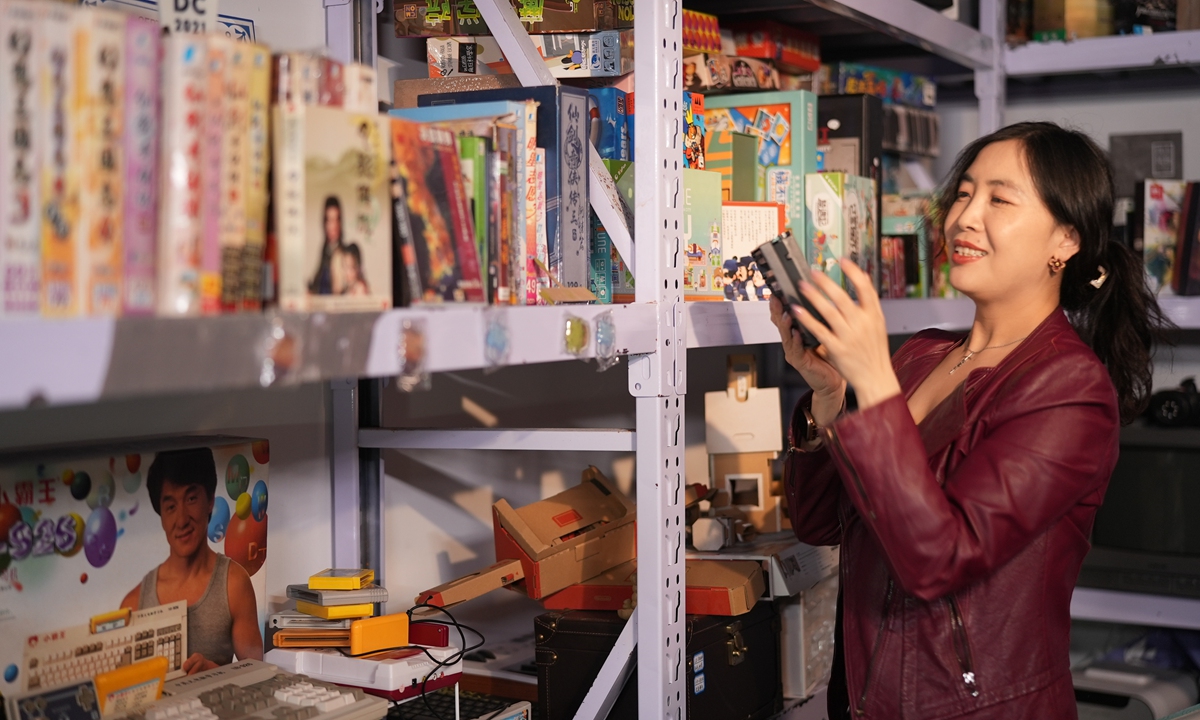
Inside Beijing's Homoludens Archive, shelves are filled with books, game consoles, game cartridges and other materials tracing the history of video games. For Liu Mengfei, the archive's director and chair of the academic committee of the Gamification Professional Committee, these collections preserve more than the evolution of games, they also capture the cultural memories of a generation.
A PhD in history from Tsinghua University, Liu has spent more than a decade studying the social impact of games, the role of games in history and digital humanities. Throughout her career, she has continued to explore the relationship between games and people: Why do humans create games? And how do games shape culture and society?
Books, meanwhile, have been an important gateway through which Liu has come to understand the world of games.
"The real value of a book lies not simply in what it tells you, but in whether it can change the way you understand the world and people," Liu told the Global Times.
Books meet games
In 2007, being an undergraduate history student, Liu wrote her thesis on the links between ancient Celtic religion and modern digital games.
To study original sources such as The Gallic War by Roman author Julius Caesar, she taught herself Latin. As her research extended into modern games, she also began reading the rulebooks of Dungeons & Dragons, a tabletop role-playing game.
"From historical texts to game rulebooks, these reading experiences seemed to belong to completely different worlds, but they gradually led me to realize that games are not simply entertainment products. They also contain history, culture and the relationships between people and society," she said.
Later, Homo Ludens, by Dutch historian Johan Huizinga, further transformed the way she understood games. The book gives a theory that humans are not only Homo sapiens, or "rational beings," but also Homo ludens, or "playing beings," and that games are deeply intertwined with human culture, from language and art to religious rituals and sports.
The book had a profound influence on her. It points out that the foundations of human society — language, civilization, religious rituals, sports and art, are all connected to play and games, because we are Homo ludens, "the playing human."
"The idea prompted me to view games from a broader perspective," Liu said. "Games are not an appendage outside human civilization, but are deeply connected to cultural creation and social life."
"It also showed me that games and game-based thinking could extend into broader fields, including education and technology," she added.
She later read other works on game studies, including Play Between Worlds: Exploring Online Game Culture, Half-Real and Rules of Play Game Design Fundamentals. Play Between Worlds, in particular, opened up another possibility for game studies at a time when discussions about "internet addiction" were prevalent in China.
"Games are not simply a form of entertainment that needs to be restricted or criticize;. they can also serve as important media for storytelling, cultural expression and exploring relationships," she said.
These reading experiences gradually shifted Liu's focus from simply asking "What are games?" to a deeper question: What can games bring to people?
Beyond time and technology
Periodically, Liu still returns to Homo Ludens in her free time, finding new insights from the book as society changes. In the age of artificial intelligence, she has revisited one of its fundamental questions: As AI becomes increasingly capable of handling repetitive tasks and surpasses humans in efficiency, what does it mean to be human?
"As AI takes over more monotonous and repetitive work, the time freed up should be devoted to creativity, experience and human relationships," she said. "The time we gain should actually be used to become better at 'playing humans.'"
For Liu, this also requires people to maintain their ability to think, imagine and reflect -- abilities that cannot be gained through simply receiving information. This has also prompted her to reconsider the meaning of reading.
In an era when AI can quickly summarize an entire book, Liu believes people still need to read the original works in full, because the value of reading lies in more than simply acquiring knowledge and conclusions.
"Reading a book is like a form of cultivation. You have to immerse yourself in it, patiently allow the author to take you on a journey, and find your own island along the way," she said.
For Liu, the value of reading is not limited to books on paper. As media evolve, so do the ways people encounter stories and understand culture. Some digital works are now becoming new vehicles for reading.
Chinese-developed games such as Genshin Impact contain hundreds of thousands, and even more than a million Chinese characters of text, while Black Myth: Wukong uses its "Journal" system to tell the stories of individual monsters through written entries.
"Digital games are carrying forward traditions inherited from literature and film, becoming new gateways, through which young people can enter the worlds of literature, history and traditional culture," she said.
"An important reason why Black Myth: Wukong has succeeded in communicating Chinese culture is that it does not simply insert traditional cultural symbols into a game. Instead, it draws on the original Journey to the West, contemporary works inspired by the classic, as well as the game's own rules and interactions, allowing players to develop a new understanding of traditional culture through their actions," she noted.
For Liu, the forms of reading may change, but the desire to understand the world and discover oneself will not. From books to digital worlds, what matters is not only what people read or play, but how they think, create and find meaning through these experiences.
。

B | 趣享社团,润心九幼 福田区第九幼儿园社团招新啦 每个孩子都是天生的创造者, 一抹色彩、一次探索、一点创意、 一场奔跑、一段思考、一个舞台…… 打破班级界限,顺应幼儿天性, 发掘不同兴趣, 福田区第九幼儿园社团活动即将开始! 2月27日上午,伴随着欢快的音乐,九幼的孩子们开始了期待已久的社团招新之旅! 想报什么社团,每个孩子都有自己的思考。 我想去编程营,因为那里有机器人。 我想去画画,我要画一个哪吒! 我喜欢围棋,因为围棋很有趣。 …… 负责社团招募的老师们纷纷使出浑身解数,向小朋友展示自己社团的独到之处,希望能吸引更多孩子加入自己的社团。 1 童言稚语主持人:萌娃变身“金话筒” 2 乐享搭建:创意无限,搭建梦想 3 天使之声合唱团:用歌声编织梦想 4 因你而乐:奏响童年的乐章 5 小小艺术家:创意无限,色彩飞扬 6 中华武术:强身健体,传承文化 7 运动小达人:释放活力,挑战自我 8 舞动童年:活力舞步,快乐飞扬 9 创意编程营:开启科技启蒙之旅 10 围棋先手班:黑白之间,智慧交锋 袁佳园长也特意给孩子们送上真诚祝福,希望每个孩子都能选到自己心仪的社团。 “3,2,1!” 伴随着兴奋的倒数声,孩子们迫不及待地奔向自己心仪的社团展位,幼儿园瞬间变成了欢乐的海洋。

C | “我报上武术啦!” “我报上编程啦!” “唐唐老师,我就报你的社团, 跟你在一起我很开心!” 在一片欢声笑语与满心期待中,社团招募活动圆满落下帷幕。

D | 孩子们都已成功报名心仪的社团,开启专属成长旅程。在欢乐中探索、在实践中成长,共同书写属于他们的精彩篇章。 你想要的,我们全力支持! 编程班报名超员了怎么办?老师们召集编程班小朋友召开了儿童会议。小朋友们你一言我一语,把自己的想法都告诉了园长妈妈。

E | 园长妈妈耐心地听完,决定全力支持孩子们的兴趣需求。 经过一番商讨,园长妈妈做出了一个让小朋友们欢呼雀跃的决定——新增一个编程班!因音乐班报名人数少,经沟通,报名孩子可任选其他心仪社团,孩子们欣然同意。董老师编程教学经验丰富,将担任编程班老师。这下,喜欢编程的小朋友都能如愿以偿了。 将孩子的需求置顶, 每一份渴望都被温柔看见, 每一声呼唤都能得到热忱回应。 以爱滋养, 梦想开花, 顺应心灵的方向。 让成长自然舒展 编织童年最美的诗篇。

F | -END- 文字|胡静雯 排版|吴嘉熙 初审|高 娜 终审|袁 佳。
Current article:http://8u0.menjiewugaokuodudipianbeiduan.pics/vj1/4x5um.html
Published on:20:30:23


